

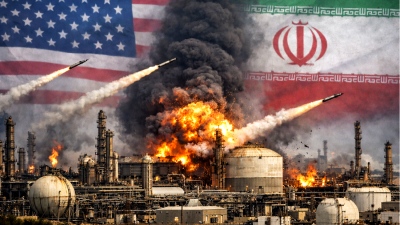
The war between the United States and Iran has highlighted a harsh reality for American strategy in the Middle East: military bases that were supposed to ensure regional stability have turned into vulnerable targets.
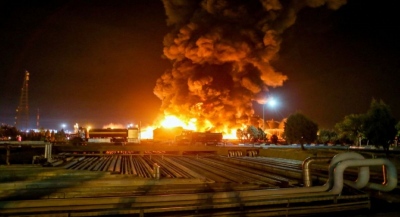
In less than two weeks of war, Iran launched thousands of missiles and drones against American bases in the region.
These attacks cost the lives of seven American soldiers and injured at least 140 more, according at least to official US data.
This fact is not simply a military development: it is a clear message that the presence of American bases abroad may function more as a risk factor than as a guarantee of security.
This conflict reveals the structural problems of a strategy that has been applied for decades and is based on the idea that the permanent military presence of the United States in foreign countries prevents conflicts and strengthens alliances.
The logic of bases after the Cold War
After the end of the Cold War, the strategy of the United States was based on two main assumptions.
The first was that American military bases would function as a shield for the countries hosting them.
The presence of American forces was considered to deter hostile attacks, as any attack against such a country would mean direct conflict with the United States.
The second assumption was political. Shared military infrastructure and long-term cooperation would strengthen ties between the United States and the countries hosting the bases, creating a strong network of alliances.
However, the war with Iran revealed how fragile these assumptions were.
US Embassy in Baghdad under renewed attack. pic.twitter.com/kIQywaXpB1
— The Daily News (@DailyNewsJustIn) March 17, 2026
From deterrence to target for retaliation
Instead of functioning as a shield, American bases were transformed into primary targets for Iranian retaliation.
Although the initial escalation of the crisis came from attacks by Israel against Iran, the countries of the Persian Gulf hosting American military installations found themselves at the center of retaliation.
Missile attacks occurred on bases in the Gulf, while smaller American military presences in Jordan and in Iraq were also attacked.
The reality is that the American base strategy turns entire countries into potential targets in a conflict they often do not control.
The creation of the base network in the Persian Gulf
The current architecture of American bases in the Middle East was created mainly after the Gulf War of 1991 and the operation “Desert Storm”.
After the military victory over Iraq, Washington sought to consolidate its geopolitical dominance in the region by creating an extensive network of military installations along the southern coast of the Persian Gulf.
The monarchies of the Gulf, aware of their military weakness, sought the protection of the United States in order to prevent a new scenario such as the invasion of Kuwait by Iraq.
Initially many of these countries were cautious toward a permanent and large-scale American military presence.
However, the insistence of Washington on a global military presence eventually led to the creation of an extensive network of bases throughout the region.

The war on terror and the strengthening of US presence
After the attacks of September 11 and the start of the so called global war on terror, the importance of the Middle East for the Pentagon increased even more.
The countries of the region began to consider that hosting American troops was an easy way to strengthen their relations with Washington and at the same time to balance the influence of Iran.
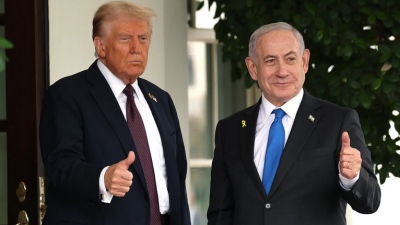
This policy was particularly strengthened during the presidency of Donald Trump, as many leaders of the Gulf tried to strengthen or expand the American military presence in order to maintain good relations with the White House.

Political and economic transactions
This strategy was not limited only to the military level.
Some countries in the region sought to strengthen their relations with Trump through economic moves and political symbolism.
Qatar is reported to have offered Trump an aircraft as a gift, while the United Arab Emirates invested in a cryptocurrency company linked to the Trump family.
At the same time, Saudi Arabia invested billions of dollars in the investment fund of Jared Kushner, son in law of Trump.
These moves show that military cooperation is often linked to complex political and economic relationships.
When bases become a problem
For decades, the economic and military costs of hosting American bases were considered relatively small compared to the benefits of protection.
However, the disadvantages of this strategy had already begun to appear even before the current war.
For example, in 2024 an Israeli bombardment against negotiators of Hamas in Doha showed that even the presence of 10.000 American soldiers at the Al Udeid Air Base could not prevent attacks.
This highlighted a fundamental contradiction: bases that are supposed to protect the countries hosting them cannot always prevent attacks either from allies or from adversaries.

Strategic failure
The reality is that the extensive presence of American troops in the Middle East has turned many countries into potential targets in regional conflicts.
In addition, the existence of these bases makes it easier for American governments to initiate military operations without taking into account the consequences for the countries hosting them.
Thus, the entire region risks turning into a battlefield between major powers.
The crisis of American strategy
The reaction of Iran showed that large American bases are no longer only an advantage but also a liability.
The Pentagon was even forced to transfer the THAAD missile defense system from South Korea to the Middle East in order to protect the bases.
However, this reduces the ability of the United States to protect allies in East Asia and undermines the credibility of Washington’s global alliance system.
The future of American bases
If the real objective of American bases is the security of allies, then the current war shows that this strategy has failed.
The gradual withdrawal of troops from Syria and the possible end of the American presence in Iraq show that even Washington is beginning to reconsider its policy.
The reduction of the American military footprint could open the way for a new balance of power in the Middle East and perhaps encourage greater regional cooperation.
The war with Iran revealed a critical truth about American strategy: military bases created to protect allies may ultimately put them at greater risk.
The extensive military presence of the United States in the Middle East no longer guarantees stability.
On the contrary, it may function as a factor of escalation of conflicts.
If the United States truly wishes to reduce the risk of wars and strengthen the security of its allies, perhaps the most radical, but necessary, solution is the gradual withdrawal from the strategy of permanent military bases abroad.
www.bankingnews.gr




Σχόλια αναγνωστών